







Our website uses cookies for the purpose of service and traffic analysis as well as advertisement. All cookies are used in accordance with our Privacy Policy. Please accept the cookies by clicking the Accept button below.
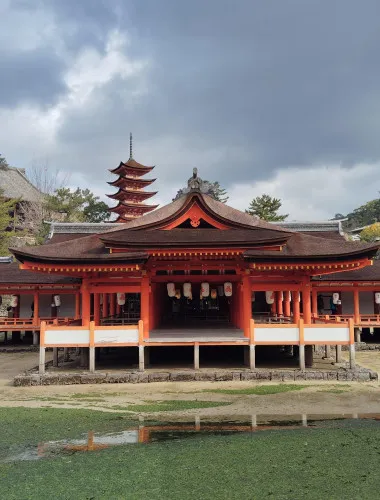
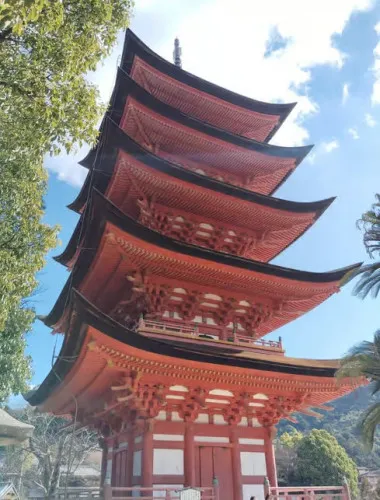
Itsukushima Shrine Five-storied Pagoda
The Itsukushima Shrine Five-Story Pagoda is a 27.6-meter-tall, five-story pagoda designated as an Important Cultural Property of Japan as well as a cultural property of Hiroshima Prefecture. It was built in 1407 and, most recently, underwent repairs in 1951, retaining its Muromachi-period appearance. Originally, it belonged to Kongō-in, a sub-temple of Daishō-in, but under the Meiji-era policy of separating Shinto and Buddhism, it was transferred to the administration of Itsukushima Shrine. More precisely, it falls under Toyokuni Shrine, a subsidiary shrine of Itsukushima Shrine. In addition, during the Shinto-Buddhist separation, the three principal images that had been enshrined inside—the seated Shakyamuni Buddha, Samantabhadra (Fugen Bosatsu), and Manjushri (Monju Bosatsu)—were moved to Daigan-ji Temple.
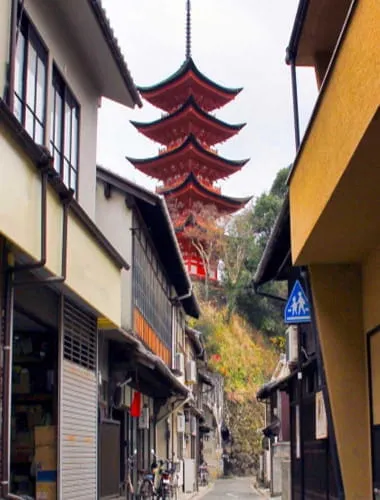
The pagoda’s roof is a superb harmony of styles: the rear rafters are arranged in parallel in the Japanese (wayō) style, while the overall silhouette curves upward in the Chinese (tōyō/karayō) style. Inside are vividly colored paintings of celestial beings such as kalavinka birds and dragons, but unfortunately the interior is not open to the public. Access to the Itsukushima Shrine Five-Story Pagoda is about a 10-minute walk from Miyajima Pier. It is also known as the place where the Sue army set up camp during the Battle of Itsukushima, fought between Mōri Motonari and Sue Harukata.
Address
〒739-0588 Hiroshima Prefecture, Hatsukaichi City, Miyajima-cho 1-1
Access
About a 10-minute walk from Miyajima Pier
Telephone
0829-44-2020 (Itsukushima Shrine)