






Our website uses cookies for the purpose of service and traffic analysis as well as advertisement. All cookies are used in accordance with our Privacy Policy. Please accept the cookies by clicking the Accept button below.
Ninnaji Temple
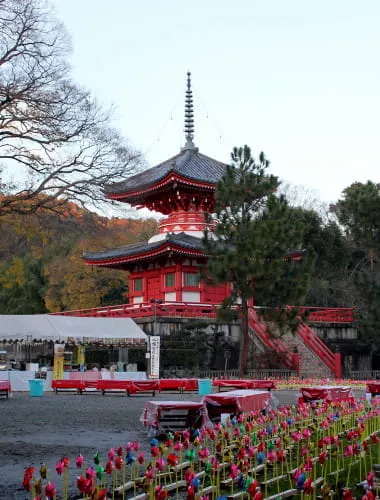
Ninna-ji Temple is the head temple of the Omuro School of Shingon Buddhism and was founded in 888. It was established on Mount Ouchi as an imperial temple by order of Emperor Koko in the second year of the Ninna era (886) and completed four years later by Emperor Uda, who carried on his predecessor’s wishes. After abdicating the throne to Emperor Daigo, Emperor Uda entered the Buddhist priesthood and set up living quarters within the temple as his base for religious practice. These living quarters, known as a "muro" meaning monks’ residence, came to be respectfully called Omuro. From the Heian to Kamakura periods, Ninna-ji flourished as a monzeki temple of the highest rank, but most of its buildings were lost to fire during the Onin War. In the Edo period, the temple was revived with donations from Tokugawa Iemitsu and buildings relocated from the Kyoto Imperial Palace. This is why the temple, also known as Omuro Imperial Palace, retains an atmosphere reminiscent of a royal residence. In spring, cherry blossoms color the temple grounds, especially the late-blooming Omuro-zakura near the west side of the Middle Gate. The road at the foot of Mount Kinugasa is called Kinukake-no-michi and connects major sightseeing spots such as Kinkaku-ji, Ryoan-ji, and Ninna-ji. The distance from Kinkaku-ji to Ninna-ji is about 2 km.
Address
〒616-8092 Kyoto Prefecture, Kyoto City, Ukyo Ward, Omuro Ouchi 22
Access
3-minute walk from Randen Omuro-Ninnaji Station
Telephone
075-461-1155
Price
Goten Hall: 500 yen for high school students and above / 300 yen for elementary and junior high school students, Reihokan Museum (limited period): 500 yen for adults / free for high school students and younger
Business Hours
09:00–17:00, until 16:30 from December to February