








Our website uses cookies for the purpose of service and traffic analysis as well as advertisement. All cookies are used in accordance with our Privacy Policy. Please accept the cookies by clicking the Accept button below.
Nijo Castle
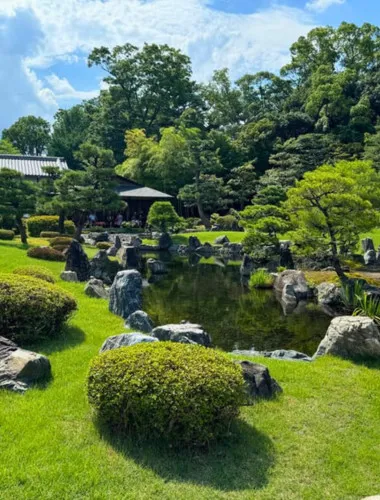
Nijō Castle (formally: Former Imperial Villa Nijō-jō) was built in 1603 by Tokugawa Ieyasu. In 1867, Tokugawa Yoshinobu, the last shogun of the Edo shogunate, announced the return of governing power to the emperor (Taisei Hōkan) here, making the castle closely tied to the rise and fall of the shogunate. It was registered as a UNESCO World Cultural Heritage site in 1994. From Kyoto Station, take a city bus to “Nijōjō-mae,” then you are right there; alternatively, the Tozai Subway Line “Nijōjō-mae Station” is adjacent. The vast grounds cover about 275,000 m², so plan at least an hour or more. After passing through the Higashi-Ōtemon Gate and entering via the Karamon Gate, you reach the Ninomaru Palace complex (six buildings). The palace is a National Treasure as a representative example of shoin-zukuri, featuring about 3,600 panels of beautiful wall paintings and intricately carved transoms. The Great Hall, where the shogun met daimyo, is especially famous, and a diorama with figures depicts the Taisei Hōkan scene. The Honmaru Palace was relocated in the Meiji era from the Katsura-no-miya family residence near the Kyoto Imperial Palace and preserves valuable traces of aristocratic life. Within the castle you can also stroll three gardens from different eras: the Edo-period Ninomaru Garden, the Meiji-period Honmaru Garden, and the Showa-period Seiryū-en.
Address
541 Nijōjō-cho, Nijo-dori Horikawa-nishi-iru, Nakagyo-ku, Kyoto City, Kyoto 604-8301, Japan
Access
Tozai Subway Line Nijōjō-mae Station: immediately; City bus “Nijōjō-mae”: immediately.
Telephone
075-841-0096
Price
Adults 1,030 yen / JHS & HS 350 yen / Elem. 200 yen
Business Hours
8:45–17:00 (last entry 16:00). Jul–Aug: 8:00–18:00 (last entry 17:00). Sep: 8:00–17:00 (last entry 16:00). Closed Dec 29–31.