







Our website uses cookies for the purpose of service and traffic analysis as well as advertisement. All cookies are used in accordance with our Privacy Policy. Please accept the cookies by clicking the Accept button below.
Yakushiji Temple
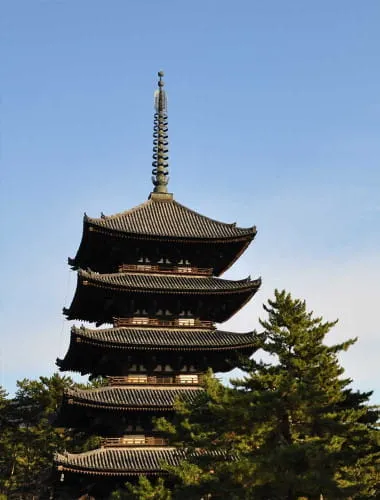
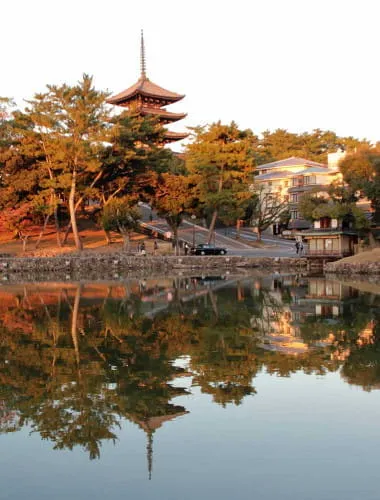
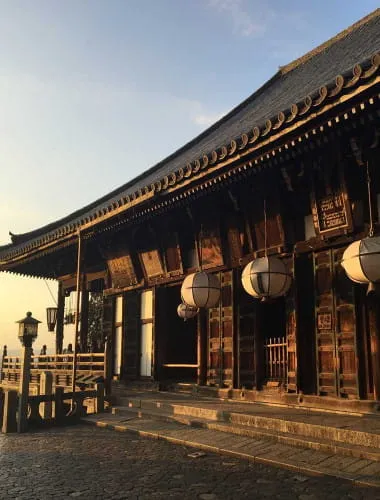
Yakushi-ji Temple was originally begun by Emperor Tenmu, who prayed for his wife’s recovery from illness (she later became Empress Jito). Because Emperor Tenmu died before completion, Empress Jito finished Yakushi-ji after the capital moved to Fujiwara-kyo. Later, with the 710 relocation of the capital to Heijo-kyo, the temple was moved to its current location right by Kintetsu Nishinokyo Station. Although Yakushi-ji was once counted among the Nanto Shichidaiji (Seven Great Temples of Nara), it fell into ruin through fires and wars; today, only the East Pagoda remains from the time of founding. The temple’s revival began after the 1960s under the leadership of Yoshin Takaida. Appearing on television, he opened copying-sutra halls nationwide and used the proceeds to rebuild key structures—first the Kondo (Golden Hall), rebuilt in 1976 to enshrine the principal Yakushi Triad. Takaida is said to have earnestly asked master carpenter Tsunekazu Nishioka—famous as Horyu-ji’s dedicated temple carpenter—to undertake the reconstruction, and received his consent. After that, the West Pagoda, Middle Gate, cloisters, Daikodo (Great Lecture Hall), and Jikido (Refectory) were successively rebuilt in Hakuhō style. Yakushi-ji is also known for entertaining Buddhist talks by its monks, a tradition said to have been started by Takaida when he was assistant head priest. A characteristic of Yakushi-ji architecture is the “Ryugu-zukuri” style, with mokoshi (pent roofs) added to each level; because of the mokoshi, the three-story West Pagoda looks like a six-story tower. The precincts also include the Genjo Sanzoin Garan, dedicated to Xuanzang (Genjo Sanzō), the founder of the Hosso school and a figure said to have inspired “Journey to the West,” where wall paintings by painter Ikuo Hirayama depicting the Silk Road are enshrined and displayed four times a year.
Address
〒630-8563 Nara Prefecture, Nara City, Nishinokyo-cho 457
Access
About a 1-minute walk from Kintetsu Nishinokyo Station; from JR Nara Station East Exit or Kintetsu Nara Station, take Nara Kotsu Bus and get off at “Yakushi-ji” or “Yakushi-ji Higashiguchi” (buses from the JR Nara Station East Exit / Kintetsu Nara Station area do not stop at the “Yakushi-ji” bus stop)
Telephone
0742-33-6001
Price
Common ticket (Kondo + Daikodo + Toin-do): Adults 800 yen / High school & Junior high 500 yen / Elementary 200 yen. Common ticket including Genjo Sanzoin Garan (Kondo + Daikodo + Toin-do + Genjo Sanzoin Garan) (only during New Year 1/1–1/8, Spring 3/1–6/3
Business Hours
8:30–17:00 (reception ends 16:30)