






Our website uses cookies for the purpose of service and traffic analysis as well as advertisement. All cookies are used in accordance with our Privacy Policy. Please accept the cookies by clicking the Accept button below.
Kosanji Temple
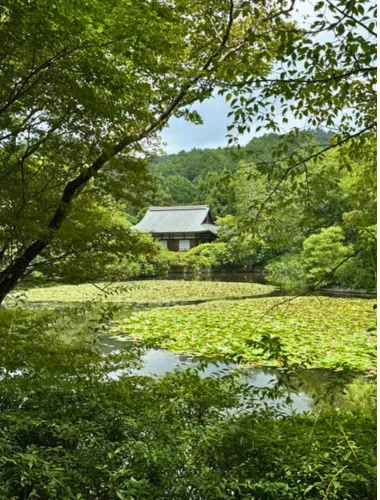
Kozan-ji is a temple in Toganoo in northwestern Kyoto, famous for the Chojugiga (‘Frolicking Animals’) scrolls. Although it originated in the Nara period, it later fell into decline until it was revived in 1206 (Ken’ei 1) by the monk Myoe Shonin as a Kegon Buddhist training site, taking the name Kozan-ji. When revived, the Sekisui-in—formerly part of a Kamo detached palace used by Retired Emperor Go-Toba—was relocated here and became Myoe’s residence. This irimoya-roof, kokera-buki building is an early Kamakura-style structure and the only surviving Kamakura-period architectural remnant at Kozan-ji. Chojugiga consists of four scrolls (A–D). Scrolls A and B are considered Heian-period works, while C and D are thought to be from the Kamakura period; each scroll differs in content. The most popular is Scroll A, which depicts anthropomorphized animals with lively brushwork. Kozan-ji is also known as Japan’s first place of tea cultivation: Myoe planted tea seeds brought back from Song China by Eisai, and this tea was called ‘honcha.’ From Kyoto Station, take a JR Bus for about an hour; get off at ‘Toganoo’ and the temple is right nearby.
Address
〒616-8295 8 Toganoo-cho, Umegahata, Ukyo Ward, Kyoto City, Kyoto Prefecture
Access
JR Bus to Toganoo; get off at ‘Toganoo’ and it’s right there
Telephone
075-861-4204
Price
Sekisui-in viewing 800 yen; during autumn foliage season only, mountain-entry fee 500 yen
Business Hours
08:30–17:00